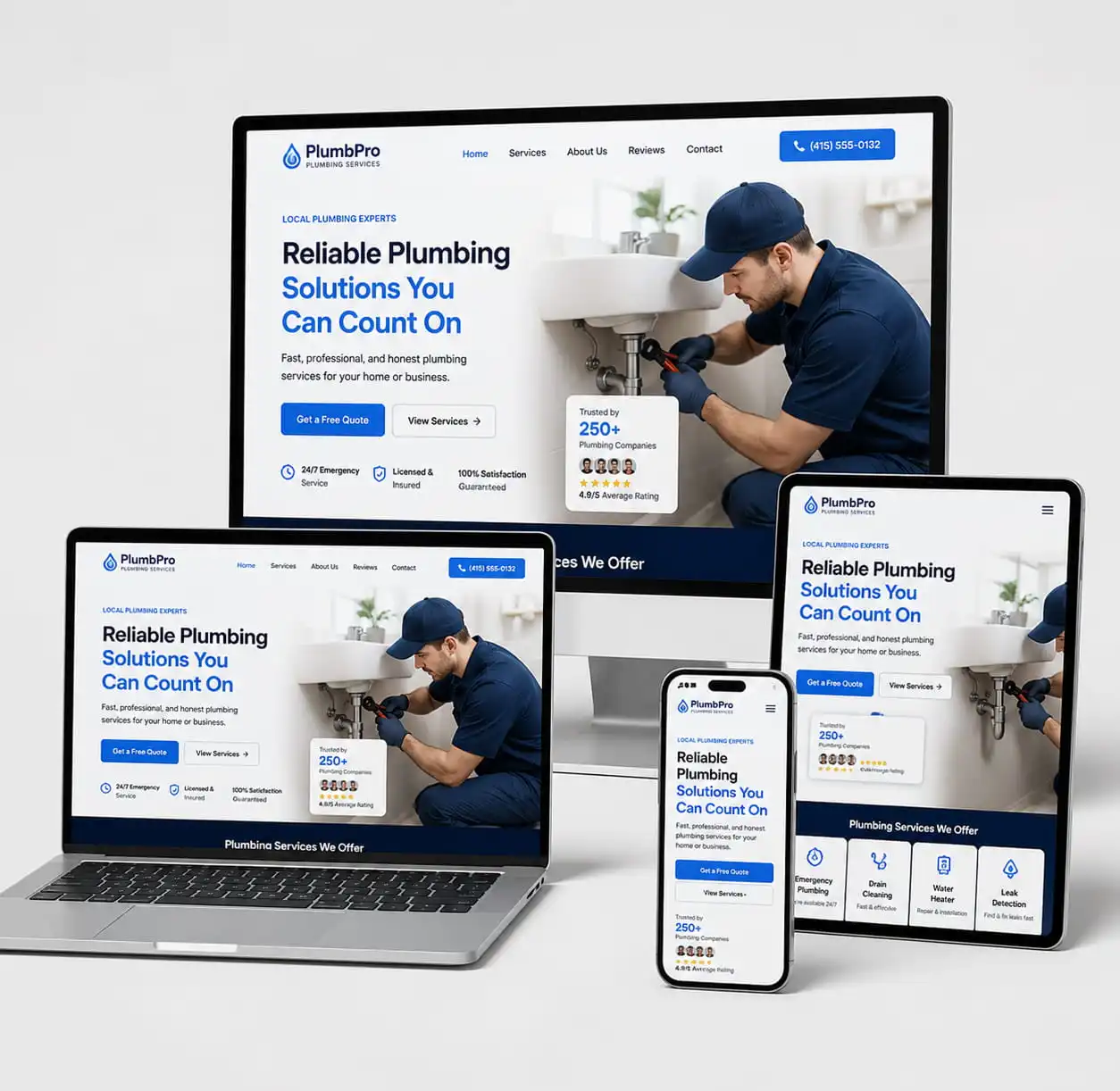
Choosing between WordPress and Webflow for a plumbing website can be confusing. Most plumbers just want a site that brings calls and ranks on Google, not technical complexity, especially when it comes to website design for plumbers.
Many websites fail because they don’t generate leads, are hard to manage, or don’t perform well in local search. This leads to lost customers and wasted effort.
In this guide, you’ll get a simple comparison of WordPress vs Webflow for plumbing websites, focusing on SEO, ease of use, cost, design, and lead generation so you can pick the right platform with confidence.
Key Differences Between WordPress and Webflow
Let’s break down the key differences between WordPress and Webflow in a simple, easy-to-follow way so you can clearly see what matters most for your plumbing website.
| Feature | WordPress | Webflow |
|---|---|---|
| Ease of Use | Moderate (needs setup) | Easy visual builder |
| SEO Strength | Very strong | Strong but limited control |
| Design Flexibility | Very high (with plugins/themes) | High (built-in visual design) |
| Speed Performance | Depends on setup | Generally fast by default |
| Cost | Low to medium | Medium to high |
| Lead Generation Tools | Excellent (plugins) | Good but limited |
| Scalability | Very high | Medium to high |
| Integrations | Massive ecosystem | Limited but clean |
| Ownership | Full control | Platform-dependent |
| Maintenance | Required (updates, plugins) | Minimal maintenance |
Ease of Use (Setup & Website Management)
Let’s look at how easy WordPress and Webflow are to set up and manage in day-to-day use for a plumbing website.
WordPress
WordPress is powerful but not very beginner-friendly at the start. It requires setup like themes, plugins, hosting, and updates.
Once set up, it becomes highly flexible for adding unlimited plumbing service pages and scaling your website easily.
Webflow
Webflow is very easy to use with a visual drag-and-drop editor. You can build and edit pages without dealing with plugins or hosting.
However, it may feel limited when you need advanced features or heavy SEO-focused expansion.
SEO Capability (Critical for Plumbing Lead Generation)
SEO is the lifeline of plumbing businesses. Most customers search things like “emergency plumber near me” or “blocked drain repair in [city]”.
WordPress
WordPress is highly SEO-friendly and allows full control with tools like Yoast SEO or Rank Math. You can optimize service pages, metadata, schema, blogs, and internal links easily.
It is especially strong for ranking plumbing websites on Google and driving consistent local leads.
Webflow
Webflow offers clean, fast, and SEO-ready websites with good built-in optimization. It handles technical SEO well without extra plugins.
However, it has fewer advanced SEO controls, making large-scale local SEO growth more limited compared to WordPress.
Design Flexibility & Customization
Now, let’s explore how much design freedom and customization you get with WordPress and Webflow when building a plumbing website.
WordPress
WordPress gives you almost unlimited design flexibility. With tools like Elementor or Gutenberg, you can easily build service pages, CTA sections, pricing tables, and lead capture forms.
You also have full control to customize everything with themes or custom code if needed.
Webflow
Webflow offers precise, pixel-perfect design control with a strong focus on modern UI/UX. It’s great for building clean and premium-looking plumbing websites.
However, creating complex multi-page structures can take more time compared to using WordPress templates.
Website Speed & Performance
Now, let’s compare how WordPress and Webflow perform in terms of website speed and overall performance for a plumbing website.
WordPress
WordPress speed depends heavily on hosting and optimization. If poorly managed, it can become slow due to heavy plugins or unoptimized themes.
But with good hosting, caching tools, and optimization plugins, WordPress can be extremely fast and competitive.
Webflow
Webflow performs well by default. It uses optimized hosting infrastructure, CDN delivery, and clean code structure.
For most plumbing websites, Webflow provides consistent speed without technical tuning.
Cost Structure
Now let’s break down the cost structure of WordPress and Webflow so you can clearly understand what you’re actually paying for in the long run.
WordPress
WordPress is free to use, but you pay for hosting, themes, plugins, and possibly developer setup depending on your needs.
It can stay very affordable for small plumbing websites or become more expensive if you add advanced features and customization.
Webflow
Webflow works on a monthly or yearly subscription that includes hosting and platform usage in one package.
It’s simpler to manage but can cost more over time compared to a self-hosted WordPress setup.
Lead Generation Features (Critical for Plumbers)
Now let’s compare how WordPress and Webflow handle lead generation, which is the most important part of a plumbing website.
WordPress
WordPress is very powerful for turning visitors into real customers. You can easily add click-to-call buttons, WhatsApp chat, booking forms, CRM tools, and live chat systems.
With the help of plugins, it becomes simple to build strong lead funnels that convert website traffic into phone calls and bookings.
Webflow
Webflow supports basic forms and simple integrations, but advanced lead generation usually requires third-party tools.
It works fine for basic contact forms, but it is less effective when you want more advanced funnels and conversion-focused features.
Scalability (Business Growth Potential)
Now let’s look at how WordPress and Webflow support long-term growth for a plumbing business.
WordPress
WordPress scales very well, whether you are running a small local plumbing business or expanding into multiple cities.
You can easily add unlimited service pages, expand location-based SEO pages, build blogs, and integrate advanced systems as your business grows.
Webflow
Webflow is scalable to a certain level, but it can become limiting for large SEO-driven plumbing websites or multi-location growth.
It works better for small to mid-sized websites rather than long-term large-scale expansion.

Plugins & Integrations
Now let’s compare how WordPress and Webflow handle plugins and integrations for adding extra features to your plumbing website.
WordPress
WordPress has the largest plugin ecosystem, giving you endless options to extend your website.
You can easily add SEO tools, booking systems, payment gateways, CRM platforms, and marketing automation features to support business growth.
Webflow
Webflow has fewer built-in integrations and usually depends on external tools like Zapier or custom code.
It keeps things simple and clean, but it is not as flexible or expandable as WordPress when adding advanced features.
Ownership & Control
Now let’s compare how WordPress and Webflow handle ownership and control of your plumbing website.
WordPress
WordPress gives you full ownership and complete control over your website.
You control the hosting, files, database, and all content, meaning your plumbing website truly belongs to you without platform restrictions.
Webflow
Webflow is a hosted platform, so while you own your content, the website still runs within their system.
If you ever decide to move away, migrating your site can be more complex compared to WordPress.

Maintenance & Security
Now, let’s compare how WordPress and Webflow handle maintenance and security for a plumbing website.
WordPress
WordPress needs regular updates for plugins, themes, and the core system to stay secure and stable.
If it is not maintained properly, it can become vulnerable, but with good setup and security tools, it remains reliable and safe.
Webflow
Webflow takes care of all maintenance and security automatically, so there are no updates or technical tasks to manage.
This makes it a great choice for business owners who prefer a completely hands-off website experience.
Which Platform Do Successful Plumbing Websites Use?
Most successful plumbing websites tend to prefer WordPress because it delivers stronger SEO performance, better lead generation tools, and long-term scalability for growing service areas and content.
It is widely used by plumbing companies that want consistent Google rankings and steady customer calls.
In simple terms:
- WordPress: Best for SEO, leads, and long-term growth
- Webflow: Best for simple, modern, design-focused websites
Webflow is still used in the industry, but mostly by smaller plumbing businesses that prioritize branding and visual design over heavy SEO and large-scale lead generation.
Final Verdict
Both WordPress and Webflow are strong platforms, but they serve different goals. WordPress is generally the better choice for plumbing businesses that want long-term growth, strong local SEO, and consistent lead generation.
Webflow, on the other hand, is a great option for businesses that prioritize clean design, simplicity, and low maintenance. It works well for smaller plumbing companies that want a modern online presence without heavy technical work.
In the end, the right choice depends on your goals—but for most plumbing businesses focused on ranking higher on Google and getting more calls, WordPress is the more powerful and proven solution.